
How Cognitive Behavioral Therapy Helps Treat Eating Disorders
What is Cognitive Behavioral Therapy?
Cognitive Behavior Therapy (CBT) is a type of therapy used for several mental disorders, including depression, anxiety, and eating disorders. (1) This type of therapy was developed by Aaron Beck in the 1960s, a psychiatrist who noticed there was a cognitive difference in what his patients with depression were saying and what they were thinking. Since then, CBT has been extensively studied and is effective for many other mental disorders. (1). Taylor Sniatecki, University of Michigan Dietetic Intern at RCBM explains further.
What does CBT consist of? CBT has been developed based on three aspects of cognition: automatic thoughts, cognitive distortions, and underlying beliefs. (1) Automatic thoughts include a person’s immediate interpretation of events that impact a person’s mood. An example of an automatic thought is a person thinking their partner is upset with them when they say good morning, causing undue stress, even though the partner did not say anything to indicate being upset. This is typically caused by the next aspect of cognition, cognitive distortions. (1)
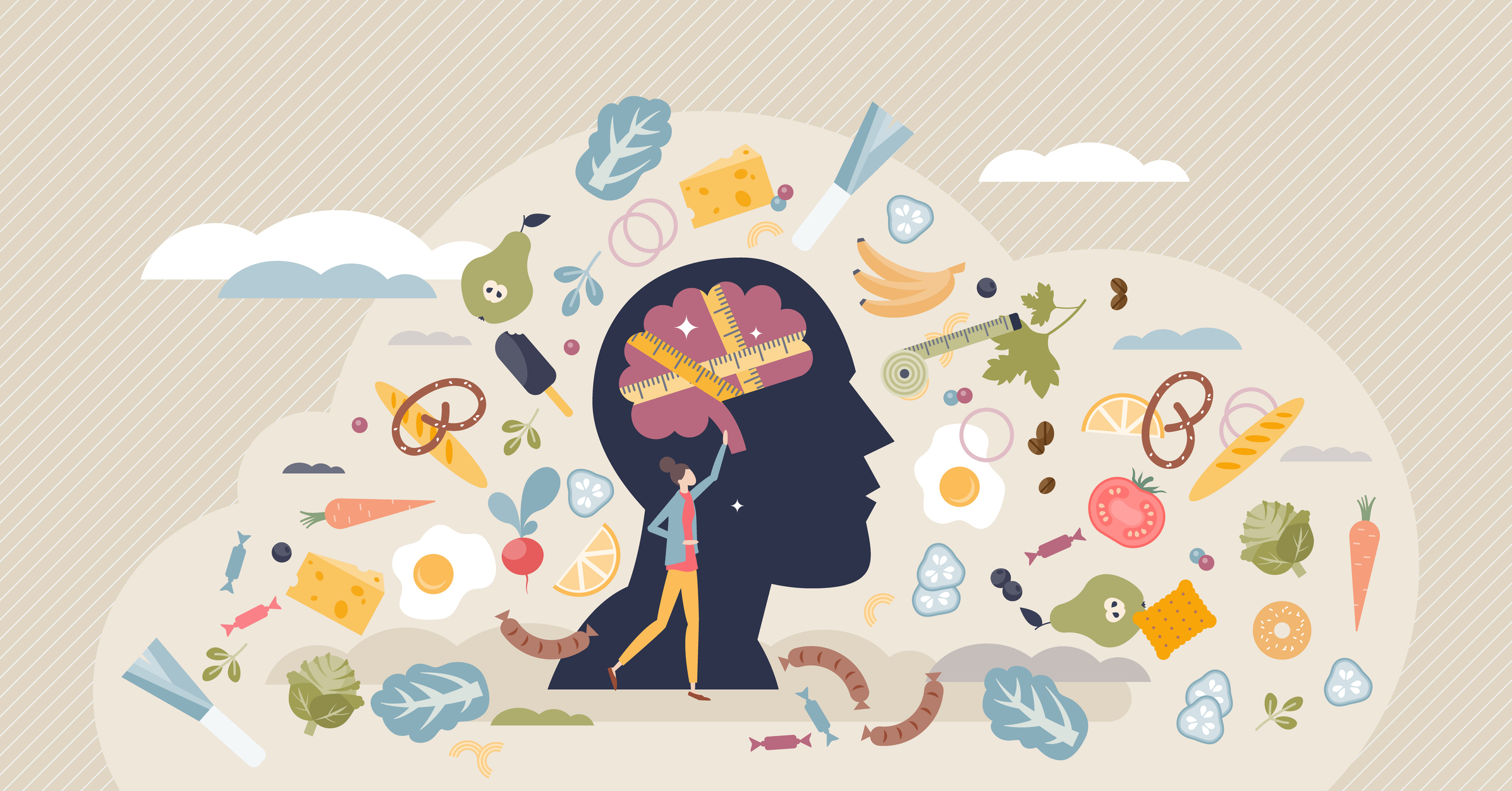
Cognitive distortions are defined as errors in logic that lead individuals to incorrect conclusions. In the example above, this person would automatically assume their partner is mad at them because of presupposed thoughts and intentions of others, or focus on the worst possible outcome. Underlying beliefs shape both automatic thoughts and cognitive distortions, the last aspect of cognition. This aspect comprises two types of beliefs: core and intermediate. Core beliefs are the most fundamental level of beliefs a person may hold, encompassing the central ideas about oneself and the world. Intermediate beliefs consist of assumptions, attitudes, and rules. (1)
Given these three aspects of cognition, CBT aims to change these faulty and distressing thinking patterns.(2) When working with CBT, individuals will be asked to learn how to recognize distortions in thinking that are creating problems and then restructuring them based in reality. This aims to gain a better understanding of the behavior and motivation of others, utilizing problem-solving skills to cope with challenging situations, and developing a greater sense of confidence in one’s own abilities. (2)
CBT and Eating Disorders: Why is it Important?
Eating disorders are complex mental disorders that are detrimental to physical and psychological health. 9% of the US population, or 30 million Americans, will have an eating disorder in their lifetime (3). According to a 2020 study, 1 person dies every 52 minutes as a direct consequence of an eating disorder. (3) Additionally, eating disorders have the second-highest mortality rate of any psychiatric illness behind opiate addiction. These staggering statistics outline the essential need for accessible and effective eating disorder treatment. (4)
Given the benefits of CBT for mental health disorders, a separate and distinct form of CBT was produced for eating disorders, called “enhanced cognitive behavior therapy,” or CBT-E, for short. This was developed by Professor Christopher Fairburn as a treatment for bulimia nervosa, and modified in the early 2000s to be a treatment for all forms of eating disorders. (5,6) Many studies have shown CBT-E to be suitable for both younger adolescent patients and adult patients in outpatient settings, in addition to inpatient and day-patient environments. Given its success in a wide variety of situations, CBT-E has become one of the most widely accepted and used forms of therapy for healthcare professionals treating eating disorders. (7)
What You Can Expect with CBT for Eating Disorders
Eating disorders are highly personal and distressing. If you or someone you know is getting CBT-E treatment for an eating disorder, it can seem scary to work through your beliefs in therapy for the first time. This is understandable! However, CBT-E is a highly individualized treatment administered by trained healthcare professionals who are committed to your best interests. Understanding the people involved and the steps of CBT-E in eating disorder treatment can make the process more manageable.
First, eating disorder treatment is recommended to be a highly collaborative, interdisciplinary approach, usually consisting of a team of mental health providers, registered dietitians, physicians, and a prescriber. (8) Although a mental health professional will be the primary person administering CBT-E, eating disorder care team members will also incorporate principles of CBT-E within their treatment. This provides care that is still highly individualized but able to incorporate the qualifications of each healthcare provider.
Four steps make up CBT-E. These are:
Stage One: Starting Well
Stage Two: Taking Stock
Stage Three: Body Image; Dietary Restraint; Events, Moods, and Eating; and Setbacks and Mindsets
Stage 4: Ending Well (7)

Diagram showing the steps of CBT-E (7)
In Stage One, there is a focus on gaining knowledge and understanding of a patient’s eating to help modify/stabilize their current eating plan to promote healthy behaviors. Education is critical at this stage, and personalized education focused on general nutrition and addressing concerns about weight is provided. (7)
In Stage Two, the focus is on reviewing progress from the initial stage. After reviewing progress, plans are made for the next step, which is considered the primary treatment stage. (7)
Stage 3 focuses on understanding the processes and beliefs that maintain the eating disorder. There will be sessions focused on addressing concerns around body image, shape, and how the patient perceives their body; addressing beliefs and debunking misconceptions around extreme dietary restraints and digging deeper into why these beliefs exist; and enhancing the ability to roll with upsetting events or moods that may trigger eating disorder behaviors. (7)
Near the end of Stage 3, setbacks and mindsets are discussed to help work through any barriers. The care team will work with the patient to ensure they have the tools to encounter past, present, and future setbacks/mindsets to ensure future success. (7)
Finally, Stage 4 focuses on maintaining the changes and progress that have been made. This may include recurring review sessions for the patient to ensure continued recovery from the eating disorder and address any remaining or new problems as they arise. (7)
In an outpatient setting, this may involve 20 treatment sessions over 20 weeks, with each treatment lasting between 30 and 60 minutes. However, this is a flexible suggestion – expected timelines may change based on the condition and its severity. (7) Remembering that CBT-E is individualized to each patient is key to its success.
Key Takeaways
Overall, eating disorders are complex, serious mental disorders that need to be treated to prevent further health complications. CBT, specifically CBT-E, has been shown to be an effective treatment method for eating disorders. If you or a loved one suspects or has been diagnosed with an eating disorder, help is out there. Our team at Rochester Center for Behavioral Medicine offers CBT-E-based care in a thoughtful, individualized, and uplifting manner that can support individuals along their path to eating disorder recovery.
References:
- Chand SP, Kuckel DP, Huecker MR. Cognitive Behavior Therapy. [Updated 2023 May 23]. In: StatPearls [Internet]. Treasure Island (FL): StatPearls Publishing; 2025 Jan-. Available from: https://www.ncbi.nlm.nih.gov/books/NBK470241/2025 American Psychological Association. What is Cognitive Behavioral Therapy? American Psychological Association. Accessed July 24, 2025. https://www.apa.org/ptsd-guideline/patients-and-families/cognitive-behavioral.
- Deloitte Access Economics. The Social and Economic Cost of Eating Disorders in the United States of America: A Report for the Strategic Training Initiative for the Prevention of Eating Disorders and the Academy for Eating Disorders. June 2020. Available at: https://www.hsph.harvard.edu/striped/report-economic-costs-of-eating-disorders/.
- Arcelus, Jon et al. “Mortality rates in patients with anorexia nervosa and other eating disorders. A meta-analysis of 36 studies.” Archives of general psychiatry 68,7 (2011): 724-31. https://doi.org/10.1001/archgenpsychiatry.2011.74
- The current status of CBT-E. CBT-E. Accessed July 24, 2025. https://www.cbte.co/what-is-cbte/current-status-cbte/.
- Fairburn CG, Cooper Z, Shafran R. Cognitive behaviour therapy for eating disorders: a "transdiagnostic" theory and treatment. Behav Res Ther. 2003;41(5):509-528. doi:10.1016/s0005-7967(02)00088-8
- A description of CBT-E. CBT-E. Accessed July 24, 2025. https://www.cbte.co/what-is-cbte/a-description-of-cbt-e/.
- National Eating Disorders Collaboration. The Care Team. National Eating Disorders Collaboration. Accessed July 24, 2025. https://nedc.com.au/eating-disorders/treatment-and-recovery/the-care#:~:text=Dietitians%2C%20psychiatrists%20and%20paediatricians%20can,support%20workers%2C%20exercise%20physiologists).