
Voices from The Front Lines
The COVID-19 pandemic has created a mental health crisis for health care workers on the front lines. Journalist Dave Hogg spoke to two women treating COVID-19 patients in the hardest hit American cities, Detroit and New York City. Both share the name “Katie,” and both are experiencing the same sense of fear and helplessness on the job. This post is part of a special series for RCBM.
“At first, I was having nightmares every night.”
“For two weeks, I didn’t sleep and I didn’t eat. It was just a constant onslaught of fear.”
That’s what life is like for medical professionals on the front lines of the fight against COVID-19.
We talked to two of them for this story. For professional reasons, we aren’t using their last names nor the names of the hospitals where they work. By sheer coincidence, they are both among the 200,000 women in the United States named “Katie.” Therefore, you will be learning the stories of New York Katie and Detroit Katie – how challenging their jobs have become, and how they’ve tried to cope with the waves of emotion they’ve each experienced.
Other than their jobs and their chosen professions, the two Katies don’t have that much in common. New York Katie is single, in her late 20s and living alone in a studio apartment. Detroit Katie is about a decade older and lives with her husband and two kids in a quiet suburb. New York Katie is a nurse practitioner at a Manhattan hospital ranked among the nation’s finest, while her Michigan counterpart is a doctor of internal medicine at a smaller urban hospital in metro Detroit.
About six weeks ago, though, their lives began to merge. When it became obvious the coronavirus was going to make a significant impact on their hospitals, they were each chosen to start putting together plans for a new COVID-19 Intensive Care Unit (CICU). Hospitals rarely invent new departments from scratch, especially under the deadline pressure put on the Katies.
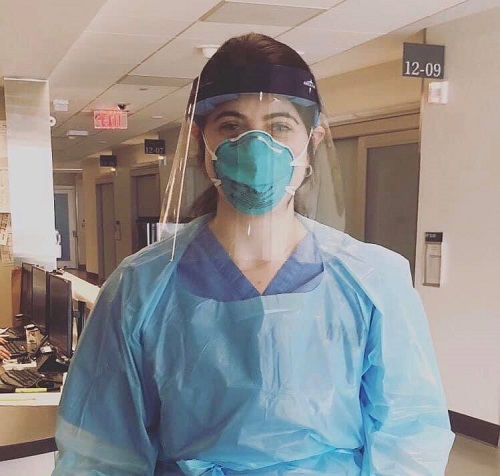
“One of my colleagues said it was like the time between seeing the lightning and hearing the thunder,” Detroit Katie said. “We knew it was coming, so we scaled up and scaled up, but there was so much we didn’t know. We knew we were going to need personal protection equipment (PPE), but that’s about it.”
It’s been more than 100 years since the Spanish Flu ravaged the planet after World War I, and 21st-century medical care is nothing like what was available in 1918. That added to the challenge facing the Katies and their colleagues across the country.
“We had to write the templates about how this was going to work,” New York Katie said. “This was a pilot program in the middle of a pandemic.”
New York Katie had a big advantage - her hospital had a new 18-story, state-of-the-art building with 374 single-patient rooms equipped with digital technology almost unmatched in the United States.
“That building was exactly what we needed for something like this,” she said. “We’ve got the most room of any hospital in the city and it is all negative pressure. Every floor is either set up for acute COVID care or COVID ICU.”
They were even equipped with ECMO - an advanced life-support system that takes over for a patient’s lungs.
“You see young people going onto an ECMO machine and you know how bad it is,” she said. “There’s nothing else we can do at that point.”
An Enormous Impact
The death toll is having an enormous impact on both women - New York City and Detroit both have per-capita death rates higher than Spain and Italy - but the fact that there’s no cure for COVID-19 is making it worse.
“You don’t decide between being a doctor or an engineer,” Detroit Katie said. “You do this because you have that need to help people. Now that’s changed.”
The Katies each had stories about the need for prioritizing their own safety over their instincts to help. There isn’t much time at home, either. Detroit Katie thinks she’s had a day-and-a-half off in the last month - and even that has changed.
“I haven’t been able to see my dad and I don’t know when I’ll see him again,” New York Katie said. “I suffer from anxiety and mental-health issues, and this has really been a challenge.”
Detroit Katie can go home to her husband - a firefighter - but contact with her kids is strictly online.
“They are at their grandparents - my parents - and having a great time, but it is hard knowing it isn’t safe for them to be here,” she said. “It was even harder when they were here, because we couldn’t let them see Mom and Dad being scared. Now we have room to let out the emotions.”
Both Katies let the tears flow when they are away from the hospital, but they also search for distractions. In New York, one Katie furiously pedals away miles on her new Peloton bike and they both look for something to watch on television.
“I’m watching a lot of British baking shows,” Detroit Katie said. “I can’t watch the news - I don’t have the emotional space right now.”
They are both hopeful that the last few days might have marked the beginning of a slow decline in cases and deaths, but they don’t expect the sharp drop-off shown in some models.
“There are still a lot of sick people and more coming in every day,” New York Katie said. “We’re going to be here as long as they need us, and we don’t know how long that’s going to take.”
David Hogg is a Content Specialist at Rochester Center for Behavioral Medicine