Transcranial Magnetic Stimulation (TMS)
Repetitive Transcranial Magnetic Stimulation (rTMS) is an innovative, FDA-cleared treatment that offers new hope for people living with depression. Designed for adults and adolescents, ages 15 and up, who haven’t found relief with medication alone, rTMS is a non-invasive therapy that targets the root of depression—brain activity—without surgery, sedation, or downtime.
Using gentle magnetic pulses, rTMS stimulates specific areas of the brain involved in mood regulation, helping restore healthier neural connections over time. Treatments are performed in a comfortable outpatient setting, typically last under 30 minutes, and allow you to return to your day immediately afterward.
With minimal side effects and strong clinical evidence supporting its effectiveness, rTMS offers a powerful alternative for those seeking lasting relief and improved quality of life. If depression has been holding you back, rTMS may be the breakthrough you’ve been waiting for.
LEARN MORE ABOUT NEUROSTAR rTMS
Understanding SPRAVATO® vs TMS
How rTMS works
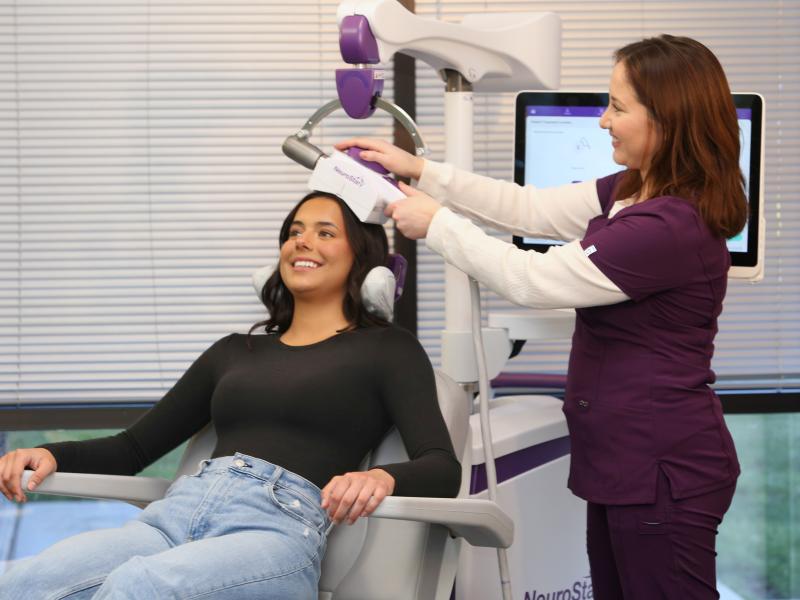
During treatment, a small magnetic coil is placed on your scalp. The coil delivers brief magnetic pulses to targeted areas of the brain that may not be working as effectively. These pulses help “wake up” brain cells and improve communication between them, which can lead to better mood and symptom relief over time.
- You are awake and comfortable during treatment
- Sessions typically last 30–40 minutes and are available from 9:00am to 3:30pm Monday to Friday
- The first visit is called a ‘mapping’ visit and lasts one hour, where we find the treatment location for each patient, with these sessions available Monday and Tuesdays at 4:00pm only
- No sedation or recovery time needed
- You can drive yourself home and return to daily activities right away
- Treatments are daily for 6 weeks with a tapering schedule for 3 weeks after
Who may benefit from rTMS
rTMS is most often used for adults or adolescents with depression (MDD), without suicidal ideation, who have not found enough relief from antidepressant medications and for adults with obsessive-compulsive disorder (OCD).
Benefits of rTMS
- No medication-related side effects like weight gain or fatigue
- Non-invasive and well-tolerated
- FDA-cleared and supported by extensive clinical research
- Can be effective when other treatments haven’t worked
Safety and side effects
rTMS is considered very safe. Some people experience mild scalp discomfort or headaches at the beginning of treatment, which usually improve after the first few sessions. Serious side effects are rare.
A personalized approach to care
At RCBM, we use NeuroStar® Advanced Therapy, which is the #1 physician-recommended rTMS treatment. NeuroStar® is the only treatment clinically proven to be effective through 12 months in patients with treatment-resistant depression (TRD). In addition, OCD treated with rTMS has shown to improve OCD symptoms.
- In adults, 83% showed improvement in depressive symptoms, and 62% achieved symptom relief (remission).
- In adolescents, 78% of patients showed improvement in depressive symptoms, and 48% achieved symptom relief (remission).
- A total of 57.9% of patients showed a greater than 30% reduction in the severity of OCD symptoms, and 52.4% experienced a sustained response.
Your treatment plan is tailored to your symptoms, history, and treatment response. Our team works closely with you every step of the way to ensure comfort, safety, and the best possible outcomes.
FAQs
Who is a good candidate for rTMS?
A good candidate for Transcranial Magnetic Stimulation (rTMS) is typically someone who meets several of the criteria below.
You may be a good candidate for rTMS if you:
✔ Have major depressive disorder (MDD) or obsessive compulsive disorder (OCD)
rTMS is FDA-cleared for 15 -75 year olds with either MDD or OCD, especially when symptoms are moderate to severe.
✔ Have not had enough relief from antidepressant medications
Many people who pursue rTMS have tried two or more antidepressants without adequate improvement or have had side effects that made medications hard to tolerate.
✔ Are looking for a non-medication treatment option
rTMS does not involve daily medication, sedation, or anesthesia.
✔ Can attend regular treatment sessions
rTMS is usually given 5 days per week for 6 weeks, so the ability to attend scheduled visits is important.
rTMS may also be appropriate if you:
- Are hoping to avoid potential medication side effects like weight gain, fatigue, or sexual dysfunction
- Want to stay alert and resume normal activities immediately after treatment
- Have depression with anxiety symptoms (many patients experience improvement in both)
Who may not be a good candidate?
rTMS may not be recommended for individuals who:
- Have a history of seizure disorder
- Have certain implanted medical devices or metal in the head, including cochlear implants
- Are unable to sit comfortably for treatment sessions
Share Link: Who is a good candidate for rTMS?
What is the difference between TMS and rTMS?
Transcranial Magnetic Stimulation (TMS) is the umbrella term for a non-invasive treatment that uses magnetic pulses to stimulate specific areas of the brain. rTMS stands for Repetitive Transcranial Magnetic Stimulation and is a specific type of TMS that uses repeated pulses. It is the most common type of TMS used in clinical practice.
Share Link: What is the difference between TMS and rTMS?
Does my insurance cover rTMS?
- Insurance coverage varies by individual health plan. We encourage you to check your insurance benefits for TMS coverage, including co-pays and deductibles. The RCBM TMS Program does not participate with TriCare, Carelon Behavioral Health, UMR, Beaumont UMR, Blue Care Network, Humana, or Medicaid. If you have one of these health plans, please visit NeuroStar to find an rTMS center that takes your insurance.
- All insurance plans require pre-authorization and ongoing authorization for TMS treatment, and each insurer has different authorization criteria. This includes a history of inadequate response to a stipulated number of classes of antidepressant medications or medications for OCD by your insurance company, with a trial of a minimum of 4 - 8 weeks each, along with augmentation strategies such as psychotherapy based on your specific insurance company criteria.
- Your psychiatrist must refer you for rTMS treatment and document the medical necessity of rTMS in accordance with the required criteria.
Share Link: Does my insurance cover rTMS?
What are common patient questions and answers about rTMS treatment?
How does rTMS work?
Certain parts of your brain help control your mood. When the connections in these areas aren’t working as well as they should, communication between brain cells slows down, which can lead to depression. rTMS helps reactivate these connections, allowing the brain to communicate more normally again.
What is involved in the initial mapping session of my rTMS treatment?
An rTMS mapping session is an appointment that helps your care team find the exact spot on your head to treat—and the right treatment strength for you.
During the session, you’ll sit comfortably in a chair while a small magnetic coil is placed against your scalp. The provider sends brief magnetic pulses and watches for a small movement in your hand or fingers. This movement allows them to observe how your brain responds and helps determine the minimum stimulation required to work safely and effectively.
Using this information, they carefully measure and mark the treatment location on your head so each session is consistent. The mapping session is not painful, does not involve needles or surgery, and usually takes 30 - 45 minutes, followed by your first treatment session, which takes 20-30 minutes. It’s an important step to personalize your rTMS treatment and make sure it’s both safe and effective.
Do I still take my psychotropic medications during rTMS treatment?
There are some medications that are contraindicated with TMS. However, for any medications that are not contraindicated, you will continue to take them as prescribed.
When will I start to feel better?
Individuals' experiences with NeuroStar® rTMS vary. The timing of when you feel improvement in your depressive symptoms may not be the same as that of other individuals. Some individuals may begin to experience positive effects within the first week, whereas others may not notice them until the end. It is important to trust the process and stay committed to all 36 treatments. Some of the positive changes include increased energy, improved sleep quality, elevated mood, better concentration, improved eating habits, restored interest in hobbies, and improved social disposition.
Share Link: What are common patient questions and answers about rTMS treatment?
Ready to get started? rTMS referral and evaluation timeline
As this is a new program at RCBM, we will process referrals in the order received. Thank you
TMS Department Contact Information:
Email: tms@rcbm.net
Phone: (586) 684-1915
Fax: (947) 230-0565
Share Link: Ready to get started? rTMS referral and evaluation timelineWatch this video to learn about Bart's story with NeuroStar rTMS treatment
Patients must have an active diagnosis of Major Depressive Disorder (adults or adolescents) or patients must have an active diagnosis of Obsessive Compulsive Disorder (adults) in order to be eligible for rTMS treatment.
Please read our TMS Adult or Adolescent Patient Brochure before submitting a Patient Interest or Healthcare Provider Referral form.
NeuroStar® Adult Patient Brochure Depression
NeuroStar® Adolescent Patient Brochure Depression
NeuroStar® Adult Patient Brochure OCD
Please note the important requirements for treatment in our program before completing the interest form or referral forms:
- Patients must have an active diagnosis of either major depressive disorder (MDD) or obsessive-compulsive disorder (OCD) for TMS treatment.
- Business hours are 9:00 am to 3:30 pm, except for Mapping visits, which are scheduled only on Mondays and Tuesdays at 4:00 pm.
- Appointments are 30 - 40 minutes long and require a 5-day per week regimen for 6 weeks
- The initial mapping session, followed by treatment, lasts one hour.
Patient Interest Form for rTMS Treatment:
For patients who have been seen by an RCBM provider within the past 6 months, please DO NOT complete the forms below. Please discuss your interest with your RCBM provider at your next appointment. Thank you!
If you are a New Patient to RCBM, please visit the “New Patient” link, also located on the navigation bar at the top of the page, and complete registration. On the registration form, you will select that you have an interest in rTMS.
Healthcare Professional Referral Form for rTMS Treatment:
Please read the information above. If you have any additional questions or concerns before completing the respective interest form, please email tms@rcbm.net.
Watch: Expert Insights on Transcranial Magnetic Stimulation (TMS)

What is TMS?
Joel Young, MD, Medical Director and Founder of RCBM explains how Transcranial Magnetic Stimulation (TMS) works and what to expect from treatment.
TMS at RCBM
Joel Young, MD, Medical Director and Founder discusses the Transcranial Magnetic Stimulation (TMS) program at RCBM and how it works along with who is a good candidate.
What to expect about the TMS Program
Oriol Paricio Sunyer, BS, TMS Program Coordinator explains how the Transcranial Magnetic Stimulation (TMS) program works at RCBM and what to expect when the patient is referred to the program.
What to expect during a TMS visit
Oriol Paricio Sunyer, BS, TMS Program Coordinator conveys what to expect during a Transcranial Magnetic Stimulation (TMS) visit. He describes the initial mapping appointment followed by the treatment sessions.